
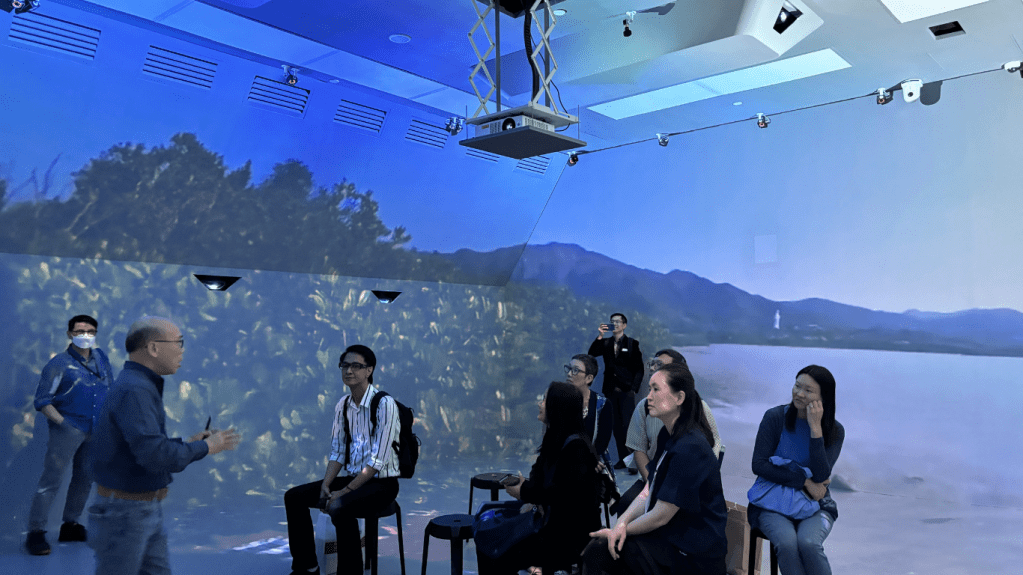
On April 24th, 2024, delegates from Naresuan University, Thailand, visited The Hong Kong Polytechnic University (PolyU) to gain insights into the university’s cutting-edge immersive learning environments. The visit provided a unique opportunity for the Naresuan University team to experience PolyU’s innovative technologies, including the HiVE (Human-Integrated Virtual Environment) and the CAVE (Cave Automatic Virtual Environment), which are revolutionizing the way social sciences are taught in the Department of Applied Social Sciences (APSS).
Highlights of the Visit
Introduction to HiVE and CAVE: Immersive Learning
The delegation from Naresuan University was introduced to PolyU’s advanced HiVE and CAVE environments, which provide students with immersive and experiential learning opportunities. These environments play a critical role in enhancing student engagement and deepening their understanding of complex social work scenarios.
- HiVE: A virtual platform that allows students to interact with realistic simulations, improving their decision-making skills in an immersive environment.
- CAVE: A fully immersive virtual reality system that enables students to experience life-like scenarios from multiple perspectives, helping them to better understand and analyze complex social issues.
Experiencing VR Simulations
The Naresuan University delegates had the chance to experience VR simulations firsthand within the HiVE and CAVE environments. These simulations are integral to the APSS curriculum and provide students with practical, hands-on learning experiences. The VR technology allows students to immerse themselves in real-world social work situations, helping them to apply theoretical knowledge in a controlled and safe setting.
The Naresuan team was impressed by how these immersive technologies are used to enhance student learning outcomes, offering PolyU students a unique opportunity to develop critical skills needed for their future careers in social work and social sciences.
The visit from Naresuan University was a significant step in fostering academic exchange and collaboration between the two institutions. Both universities look forward to continued discussions on how immersive technologies can be further integrated into social sciences education to better prepare students for the challenges of the modern world.
 PolyU APSS CSD